Martí Llorens (Barcelona, 1962) holds a BA in Fine Arts (Image) from the University of Barcelona and an MA in Theory and History of Architecture from the Polytechnic University of Catalonia. He is a photographer specializing in the documentation of architectural, engineering, and urban projects. In 2017, he co-founded Factoría Heliográfica with Rebecca Mutell, a cultural association devoted to research on the origins and early history of photography. His artistic and research practice examines the relationships between time, territory, memory, and image, and has been exhibited and published internationally since 1988. His personal work explores time, memory, and territory, with projects such as Poblenou, which received second prize at the European Photography Award (Berlin, 1991). Interested in the origins of photography, in 2015 he co-directed the restoration and research of the Daguerre-Giroux photographic equipment, with which the first photograph in Spain was taken in 1839. He is co-editor of the essay Buscando lo imposible. Una antología de textos sobre el origen de la fotografía (University of Navarra Museum, 2024). His work is part of public and private collections.
Rebecca Mutell (Aranda de Duero, 1980) holds a PhD in Fine Arts from the University of Barcelona and received the Extraordinary Doctoral Award for her dissertation Catching the Light: Origin and Materiality of Photography. She is a lecturer and researcher at BAU, Centre Universitari d’Arts i Disseny (UVic-UCC), where she is a member of the GREDITS research group and serves as Head of Department. She currently co-directs Factoría Heliográfica with Martí Llorens. Her research focuses on the phenomenology of the photographic image and its technical and iconological precedents, and her work has been exhibited and published internationally.
Barcelona’s nomination as the host city for the 1992 Olympic Games led to significant urban redevelopment in the city. One of these projects involved the transformation of the waterfront of the Poblenou neighborhood; Avinguda d’Icària (Icaria Avenue) structured this area, which was characterized by factories, workshops, and railway tracks. This is where a new residential neighborhood, the Olympic Village, was built. The scale and impact —both physical and social— of this project made it comparable to other major transformations such as the 1888 Universal Exposition, the opening of Via Laietana that began in 1908, or the 1929 Universal Exposition.
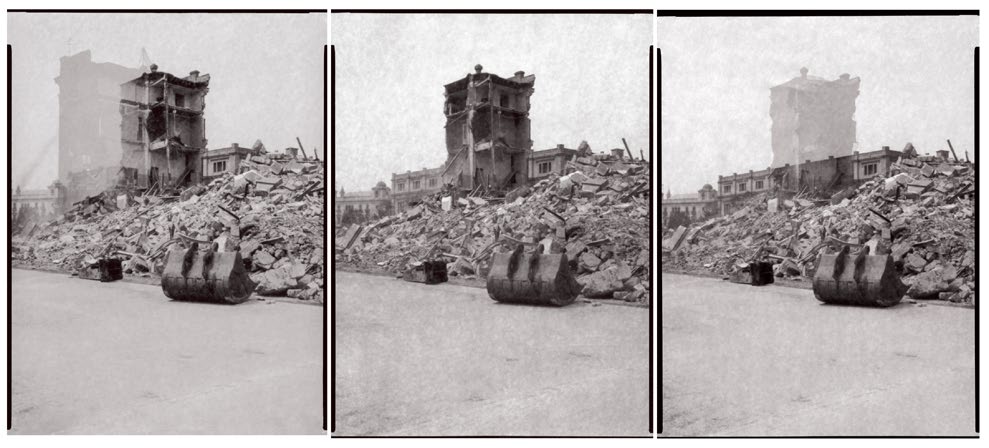
In July 1987 the demolition of the Icaria neighborhood began. In this construction zone, Martí Llorens began a creative photographic project using a pinhole camera, a camera in which the lens is replaced by a tiny hole. Soon after, this project led him to document, with conventional photographic equipment, the construction of the new neighborhood until 1992.
Almost forty years have passed since the beginning of the demolitions in Poblenou. The relationship we have with photography today is very different from the one we had at the end of the 20th century, as are the links created with everything seen and imagined through it. Now, by digitizing and viewing on screen the photographs of what we now call the Icarian Archive, an interesting and fruitful transversal re-reading is generated that endows these images with new meanings. Having lost their physical nature, it seems that these photographs demand to be approached and interpreted from other parameters. Our relationship with all of them seems to have changed and, of course, also with the city they show. The need to recontextualize and reinterpret their contents in different layers, creating new links, is an essential part of this article.
Didi-Huberman, Georges, y Henri Herré. 2023. Tables de montage: regarder, recueillir, raconter. Editado por Nathalie Léger. Le lieu de l’archive. Saint-Germain-la-Blanche-Herbe, France: Éditions de l’IMEC.
Fontcuberta, Joan. 1997. El beso de Judas: fotografía y verdad. Barcelona: GG. Ediciones Gustavo Gili.
Llorens, Martí, y Rebecca Mutell, eds. 2024. Buscando lo imposible: una antología de textos sobre el origen de la fotografía. Traducido por Ana Galán. I: Utopía, Vol II: Materialidad y Vol III: Praxis. Pamplona: Museo Universidad de Navarra.
Martorell, Josep Maria, Oriol Bohigas, David Mackay, y Albert Puigdomènech. 1991. La Villa Olímpica, Barcelona 92: arquitectura, parques, puerto deportivo = The Olympic Village, Barcelona 92: architecture, parks, leisure port. Barcelona: GG. Ediciones Gustavo Gili.
Mitchell, William John. 1994. The Reconfigured Eye: Visual Truth in the Post-Photographic Era. Cambridge: MIT Press.
Mumford, Lewis. 2015. Historia de las utopías. Segunda edición. Traducido por Diego Luis Sanromán. Logroño: Pepitas de
calabaza.
Navas Perrone, Maria Gabriela. 2016. «Utopía y privatopía en la Vila Olímpica de Barcelona: Los impactos sociales de un barrio de autor». En TDX (Tesis Doctorals en Xarxa). Ph.D. Thesis, Universitat de Barcelona, marzo 25. https://www.tdx.cat/handle/10803/401430.