Josep Oriol Ferrer Frau (Mallorca, 1992) is an architect graduate from the School of Architecture of Barcelona (UPC-ETSAB), where he also completed a Master’s in Advanced Studies, specializing in Project, Process, and Programming. During his academic career, he served as an assistant in the Habitatge i Ciutat course. He is currently a predoctoral researcher (FPU) and a member of the FORM+ research group at UPC, focusing on collective housing, architectural design, and urban processes. Universitat Politècnica de Catalunya, Barcelona, España.
This study examines the evolution of functionalism in Denmark through the lens of the collective housing project at Ordrupvej No. 70 (1937), a landmark work by architect Mogens Lassen (1901–1987) and engineer Ernst Ishøy (1890–1959). The analysis situates the project within the broader context of Danish functionalism, contrasting the international influences of figures such as Le Corbusier (1887–1965) and Walter Gropius (1883–1969) with the local “functional tradition” articulated by architects like Kay Fisker (1893–1965), C.F. Møller (1898–1988), and Arne Jacobsen (1902–1971).
A key focus of the inquiry is on the innovative construction techniques employed at Ordrupvej No. 70, particularly the use of a patented sliding formwork system known as Systemhuset. This system facilitated a rapid and cost-effective construction process and is critically analyzed in terms of its contribution to modularity and prefabrication in residential architecture. The central hypothesis is that Ordrupvej 70 represents not only a technical achievement but also a cultural negotiation between Danish tradition and international modernism, anticipating later debates on industrialized housing.
The study is further enriched by historical photographs documenting the construction process. These images capture the intermediate stages of the building’s evolution, providing visual evidence of the methods and challenges associated with the implementation of the new construction system. This photographic documentation is integral to understanding the dynamic process of construction and the practical application of modular techniques in mid- 20th-century Danish architecture.
Overall, the analysis highlights the contribution of Lassen and Ishøy’s collaboration as one of the earliest and most coherent experiments in integrating modular construction and prefabrication into collective housing, offering new perspectives for the historiography of modern architecture in Scandinavia.
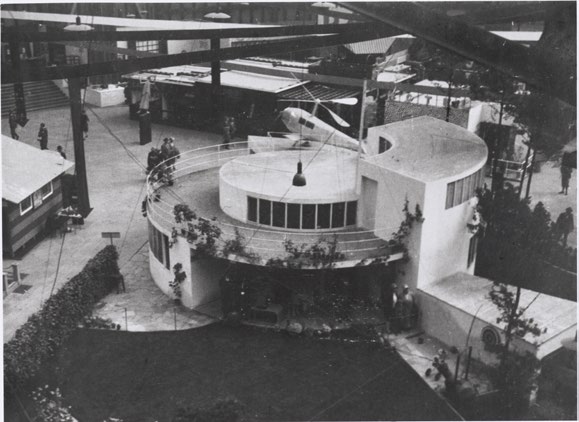
Cover image: House of the future
References
Banham, R. 1980.Theory and Design in the First Machine Age. MIT Press.
Benton, T. 2007.The Modernist Home. V&A Publications.
Bergdoll, B. & Christensen, P. 2008. Home Delivery: Fabricating the Modern Dwelling. MoMA.
Birch, K. 1980. “Funktionalisme–borgerlig utopi og socialistisk vision.” Arkitekten, 8: 190-193.
Curtis, W. J. R. 1996. Modern Architecture Since 1900. Phaidon.
Dirckinck-Holmfeld, K., Keiding M. 2007. Danish Architecture since 1754. Danish Architectural Press.
Frampton, K. 2020. Modern Architecture: A Critical History. 5th ed., Thames & Hudson.
Ishoy, E. 1937. “Systemhuset.” Arkitekten 37: 173–175.
Jorgensen, L. 1980. “En ny tid I funkis.” Arkitekten 8: 179-183.
Lassen, M. 1939. “Beboelsesbygning paa Ordrupvej.” Arkitekten 10: 150-153.
Lund, N. 1980. “Funktionalism i Danmark.” Arkitekten 8: 184-189.
Millech, Knud, and Kay Fisker. 1951. Danske arkitekturstrømninger 1850–1950: En arkitekturhistorisk undersøgelse. Østifternes Kreditforening.
Mollerup, J. 1989. “Levende Arkitekture.” Arkitekten 22: 568–569.
Nygaaed, E. 1980. “Funktionalisme og arbejdernes boliger”. Arkitekten 8: 202-104.
Perret, A. 1952. “Contribution à une théorie de l’architecture” Círculo de estudios de arquitectura.
Sestoft, J, Christiansen, J. 2015. Guide to Danish Architecture 1000–1960. Arkitektens Forlag.
Sestoft, J. 1980. “Den nye and.” Arkitekten 8: 174-178.
Skriver, P. E. 1972. “Arbejder af Mogens Lassen.” Arkitekten 2: 49-93.
Skriver, P. E. 1980. “Da funktionalsime sivede ind i Danmark” Arkitekten 2: 195-200.
Wedebrunn, O. 2002. “Modernisme, Renovering, Teknologisk Fornyelse.” Arkitekten 2: 2-13.