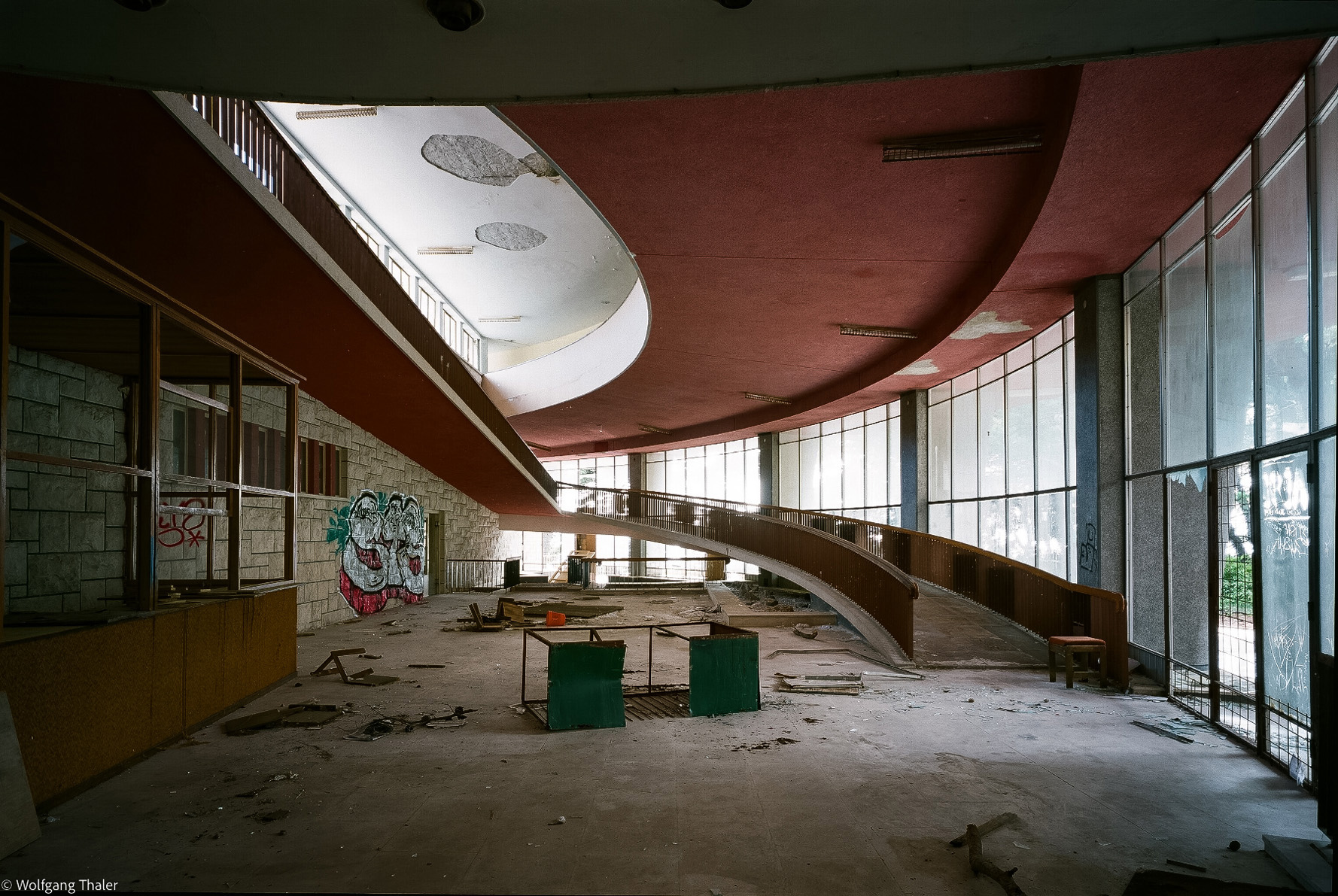
The article examines the multi-layered roles of photography and film in “cultural translation,” representing architecture and landscape as a mediated place of conflicting visions, meanings and experiences. Taking the concept of the “production of space” as a starting point, it aims to contextualise the mediatory practices of photography and film by means of analysing the case study of a multifunctional building – the Krvavica Children’s Health Resort – designed in the 1960s by Rikard Marasović on the Adriatic coast of Croatia (formerly Yugoslavia). Focusing on an analysis of three paradigmatic examples of visual practices, the photographic series by Wolfgang Thaler (2011), the episode Mysterious Object in the Pine Forest filmed as part of the documentary series Slumbering Concrete (2016), and the experimental film A Record of Landscape without Prehistory by the artistic duo Doplgenger (2020), the article explores how photography and film communicate quality, in particular how mediated representations (re)create current interpretation and understanding of the intertwined heritage of modern architecture and landscape. Examining aspects of recording the site from different perspectives, a series of questions arise when addressing the issue of space, focused on its role in reshaping meanings, memories, emotions and experiences, narrating not only what architecture and landscape are but also what they could become and how they might be constituted in the context of different cultural identities.
References
Bjažić-Klarin, Tamara. Ernest Weissmann: Društveno angažirana arhitektura 1926.–1939. [Socially Engaged Architecture 1926–1939]. Zagreb: Hrvatska akademija znanosti i umjetnosti, 2015.
Briegleb, Till. “The Dirty Magic of Failure.” In Roman Bezjak: Socialist Modernism, edited by Inka Schube, 144–147. Ostfildern bei Stuttgart: Hatje Cantz, 2011.
Buchli, Victor and Lucas Gavin, eds. The Absent Present: Archaeologies of the Contemporary Past. London: Routledge, 2001.
Groys, Boris. Public space: From emptiness to paradox. London-Moscow: Strelka Press, 2012.
Moravánszky, Ákos and Judith Hopfengärtner, eds. Re-Humanizing Architecture: New Forms of Community, 1950–1970. Basel: Birkhäuser Verlag, 2017.
Moravánszky Ákos and Karl R. Kegler, eds. Re-Scaling the Environment: New Landscapes of Design, 1960–1980. Basel: Birkhäuser Verlag, 2017.
Moravánszky, Ákos and Torsten Lange, eds. Re-Framing Identities: Architecture’s Turn to History, 1970–1990. Basel: Birkhäuser Verlag, 2017.
Mrduljaš, Maroje and Vladimir Kulić. “Scenes from an Unfinished Modernisation.” Hintergrund 54: 19th Vienna Architecture Congress: Soviet Modernism 1955–1991. Unknown Stories. Architekturzentrum Wien, 2012, 66–77.
Mrduljaš, Maroje, Vladimir Kulić and Wolfgang Thaler, eds. Modernism In-between: The Mediatory Architectures of Socialist Yugoslavia. Berlin: Jovis, 2012.
Nora, Pierre. “Between Memory and History: Les Lieux de Mémoire.” Representations, Special Issue: Memory and CounterMemory 26 (Spring 1989): 7–24.
Obad-Šćitaroci, Mladen, ed. Sveučilište u Zagrebu-Arhitektonski fakultet, 1919./1920.–1999./2000. osamdeset godinaizobrazbe arhitekata u Hrvatskoj. Zagreb: Arhitektonski fakultet Sveučilišta u Zagrebu, 2000.
Pejković, Sanjin. “Displaced Film Memories in the post-Yugoslav Context.” Contemporary Southeastern Europe 4 (2017) 2: 89–101.
Skopin, Igor. “Rikard Marasović (1913–1987).” Čovjek i prostor (411) 6 (1987): 5.
Premerl, Tomislav. “Pobjeda moderne.” Arhitektura 30 (156–157) (1976): 41–54.
Stierli, Martino and Vladimir Kulić, eds. Toward a Concrete Utopia: Architecture in Yugoslavia 1948–1980. New York: MOMA, 2018.
Todorova, Maria. Imagining the Balkans, New York-Oxford: Oxford University Press, 1997.
Todorova, Maria and Zsusza Gille, eds. Post-communist Nostalgia, New York-Oxford: Berghahn Books, 2010.
Wegerhoff, Erik. ‘Neue Sinnlichkeit. Postcritical Issues Regarding an Architecture of Sensuousness.” Future Anterior: Journal of Historic Preservation, History, Theory, and Criticism 13 (2016) 2: 119–137.
Zielinski, Siegfried. Deep Time of the Media: Toward an Archaeology of Hearing and Seeing by Technical Means. Cambridge, MA: The MIT Press, 2006.