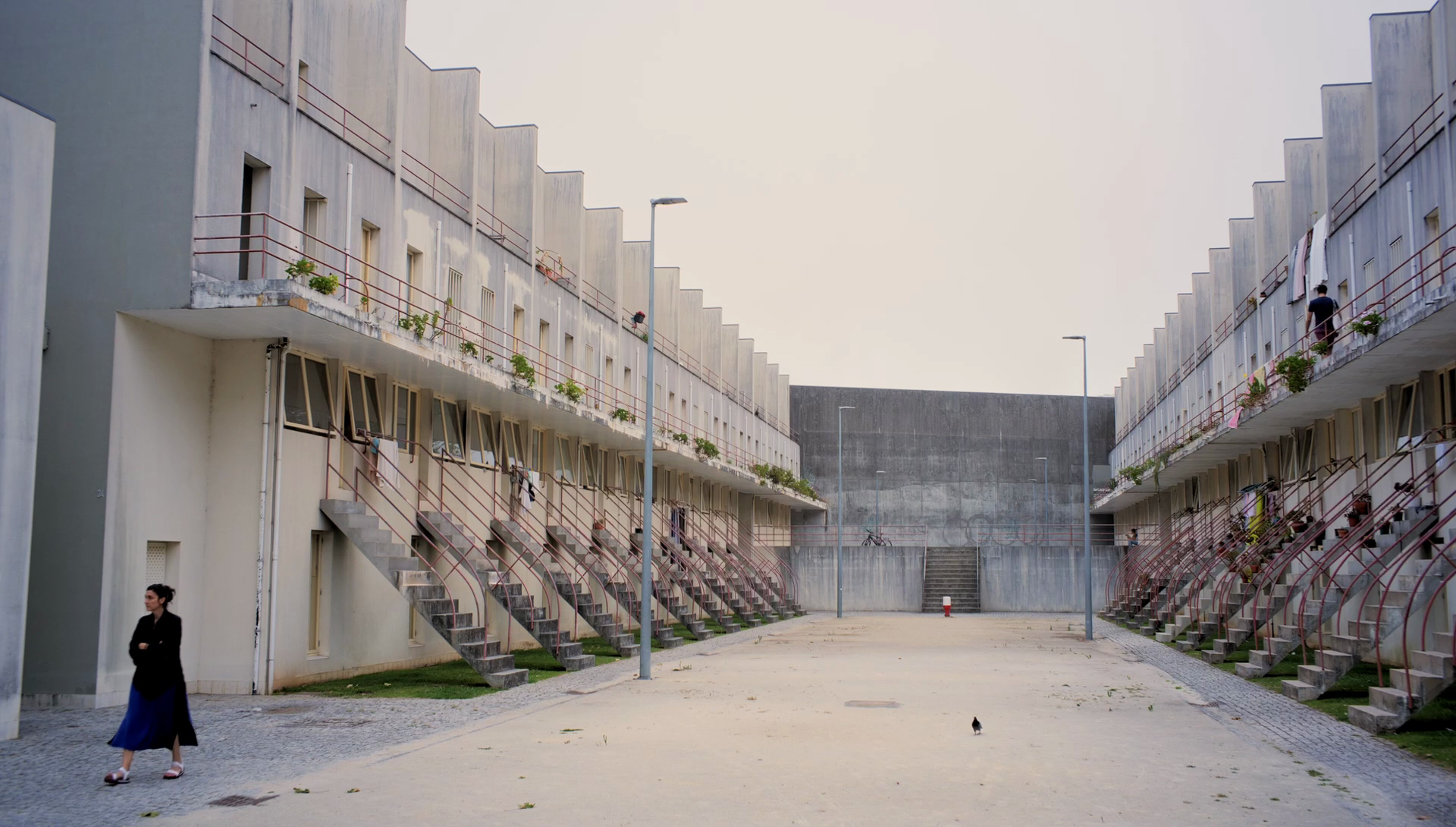
This paper explores the different ways residents of famous buildings experience the architecture they live in. We aim at an architectural photography that seeks to portray architecture not as a visual phenomenon but rather a lived one. We have photographed residents of the Bouça housing estate in Porto, Portugal, designed in the 1970s by Pritzker Prize winning Portuguese architect Álvaro Siza to house the urban poor after the 1974 revolution. The estate has since become an architectural icon and is currently undergoing gentrification by architects, designers and artists who are drawn to the appeal of ‘auteur architecture’. The differences in inhabitation between the original residents and the recent ones pertain to a complex yet dualistic stance between two distinct social classes on what architecture is and what it means, one that also raises the issue of housing for the urban poor becoming fashionable. We read such tensions while tracing back to Siza’s early belief in a classless society, which later evolved into the belief in an ‘interclassist city’.
Cover image: Costa et al., “Inhabiting Auteur Architecture.”
Bhabha, Homi. “The World and the Home.” In Dangerous Liaisons: Gender, Nation, and Postcolonial Perspectives, edited by A. McClintock, A. Mufti, and E. Shohat, 445-455. Minneapolis: University of Minnesota Press, 1997.
Boughton, James. Municipal Dreams: The Rise and Fall of Council Housing. London: Verso, 2018.
Bourdieu, Pierre. Outline of a Theory of Practice. Cambridge: Cambridge University Press, 1977.
Butler, Tim, and Garry Robson. “Social capital, gentrification and neighbourhood change in London: a comparison of three south London neighbourhoods.” Urban Studies 38, n..12 (2001): 2145-2162. https://doi.org/10.1080/00420980120087090.
Colomina, Beatriz. Domesticity at War. Cambridge, MA: MIT Press, 2007.
Colomina, Beatriz. Privacy and Publicity: Modern Architecture as Mass Media. Cambridge, MA: MIT Press, 1996.
Costa, Ana Catarina. O campo da arquitectura na construção da cidade democrática: o Processo SAAL/Porto. PhD diss., Faculdade de Arquitectura da Universidade do Porto, 2022.
Costa, Ana Catarina, Marta Machado, Paulo Catrica and Eduardo Ascens.o. “Inhabiting auteur architecture: tracing the residents’ experience of .lvaro Siza’s Bou.a housing estate”. Social and Cultural Geography (2025): 1-21. https://doi.org/10.1080/14649365.2025.2464016.
Donat, John. “The Camera Always Lies.” Royal Institute of British Architects Journal 75 (1968): 62-71.
Duarte, Mariana. “As Discuss.es eram de uma Sinceridade Absoluta.” Público, November 9, 2014.
Elwall, Robert. Building with Light: An International History of Architectural Photography. London: Merrell, 2004.
Heidegger, Martin. “Building Dwelling Thinking.” In Basic Writings: From Being and Time (1927) to The Task of Thinking (1964), 343-363. San Francisco: Harper, 1993 (or. 1964).
Jackson, Emma, and Tim Butler. “Revisiting ‘social tectonics’: The middle classes and social mix in gentrifying neighbourhoods.” Urban Studies 52.13 (2015): 2349-2365. https://doi.org/10.1177/0042098014547370.
Jacobs, Jane M., Stephen Cairns, and Ignaz Strebel. “Doing Building Work: Methods at the Interface of Geography and Architecture.” Geographical Research 50 (2) (2012): 126-140. https://doi.org/10.1111/j.1745-5871.2011.00737.x.
Jacobs, Jane M., Stephen Cairns, and Ignaz Strebel. “Windows: Re-viewing Red Road.” Scottish Geographical Journal 124 n.s. 2-3 (2008): 165-184. https://doi.org/10.1080/14702540802438488.
Jacobs, Jane M., Stephen Cairns, and Ignaz Strebel. “SUYH Show Us Your Home.” Highrise Project, Methodologies. 2006. http://www.highrise.eca.ed.ac.uk/.
Kraftl, Peter. “Living in an Artwork: The Extraordinary Geographies of the Hundertwasser-Haus, Vienna.” cultural geographies 16, n.. 1 (2009): 111–134. https://doi.org/10.1177/1474474008097982.
Kraftl, Peter, and Peter Adey. “Architecture/Affect/Inhabitation: Geographies of Being-in Buildings.” Annals of the Association of American Geographers 98, n..1 (2008): 213-231. https://doi.org/10.1080/00045600701734687.
Lees, Loretta. “Towards a Critical Geography of Architecture: The Case of an Ersatz Colosseum.” Ecumene 8, n..1 (2001): 51-86. https://doi.org/10.1177/096746080100800103.
Llewellyn, Mark. ‘Urban village’or ‘white house’: envisioned spaces, experienced places, and everyday life at Kensal House, London in the 1930s. Environment and planning D: Society and Space, 22, n.. 2 (2004): 229-249.
Rosa, Joseph, and Esther McCoy. A constructed view: The architectural photography of Julius Shulman. New York: Rizzoli, 1994.
Serraino, Pierluigi. Julius Shulman: Modernism Rediscovered. Cologne: Taschen, 2018.
Siza, .lvaro. “The line of action of the technicians as technicians.” Lotus International 13 (1976): 87.
Siza, .lvaro. “Viver uma Casa” (1994). In Álvaro Siza: Obras e Projectos, edited by P. Llano and C. Castanheira, 94-95. Madrid: Electra, 1995.
Teixeira, Manuel C. Habitação Popular na Cidade Oitocentista: As Ilhas do Porto. Lisboa: Funda..o Calouste Gulbenkian, 1996.
Wang, Wilfried. “Bou.a and Public Housing at the Beginning of the 21st Century.” In Bouça Residents’ Association Housing: Porto 1972-77, 2005-06, edited by .. Siza, B. Fleck, and W. Wang, 65-70. Austin: University of Texas, 2008.